Istanbul welcomes hundreds of thousands of health tourists every year. From cosmetic surgery to dental treatment, from hair transplants to eye surgery, why is Istanbul chosen?

In recent years, Istanbul has become one of the world's most preferred health tourism hubs in many fields, especially cosmetic surgery, dental treatments, hair transplants and eye surgeries. Hundreds of thousands of patients from Europe, the Middle East and Gulf countries choose Istanbul for treatment every year.
Behind this preference lies not just affordable cost, but also an experienced medical staff, JCI accredited hospitals, and the ability to combine the treatment process with a comfortable travel experience.


Treatments of the same quality as in Europe and the US are typically offered in Istanbul at 50-70% lower cost. This price advantage comes without compromising quality standards, many private hospitals hold international JCI (Joint Commission International) accreditation.
In addition, Istanbul's geographic location makes it reachable within a 3-4 hour flight from a wide region spanning from Europe to the Middle East, which also makes post treatment follow up visits practical.
Hair transplants (FUE technique), cosmetic surgery (rhinoplasty, liposuction), dental treatments (implants, zirconia crowns) and eye surgeries (LASIK/LASEK) are among the most in demand health tourism fields in Istanbul.
Clinics specialized in these fields, with international patient experience, offer patients not just treatment, but a complete 'health package' including accommodation, transfer and interpretation services.
Tip: The most important thing to clarify with the clinic before treatment is whether all costs (examination, procedure, follow up, medication) are included in the package.
Waiting in a taxi queue at the airport after a surgery or medical procedure, trying to find your way in a foreign city, this is an unnecessary source of stress and physical fatigue for a patient.
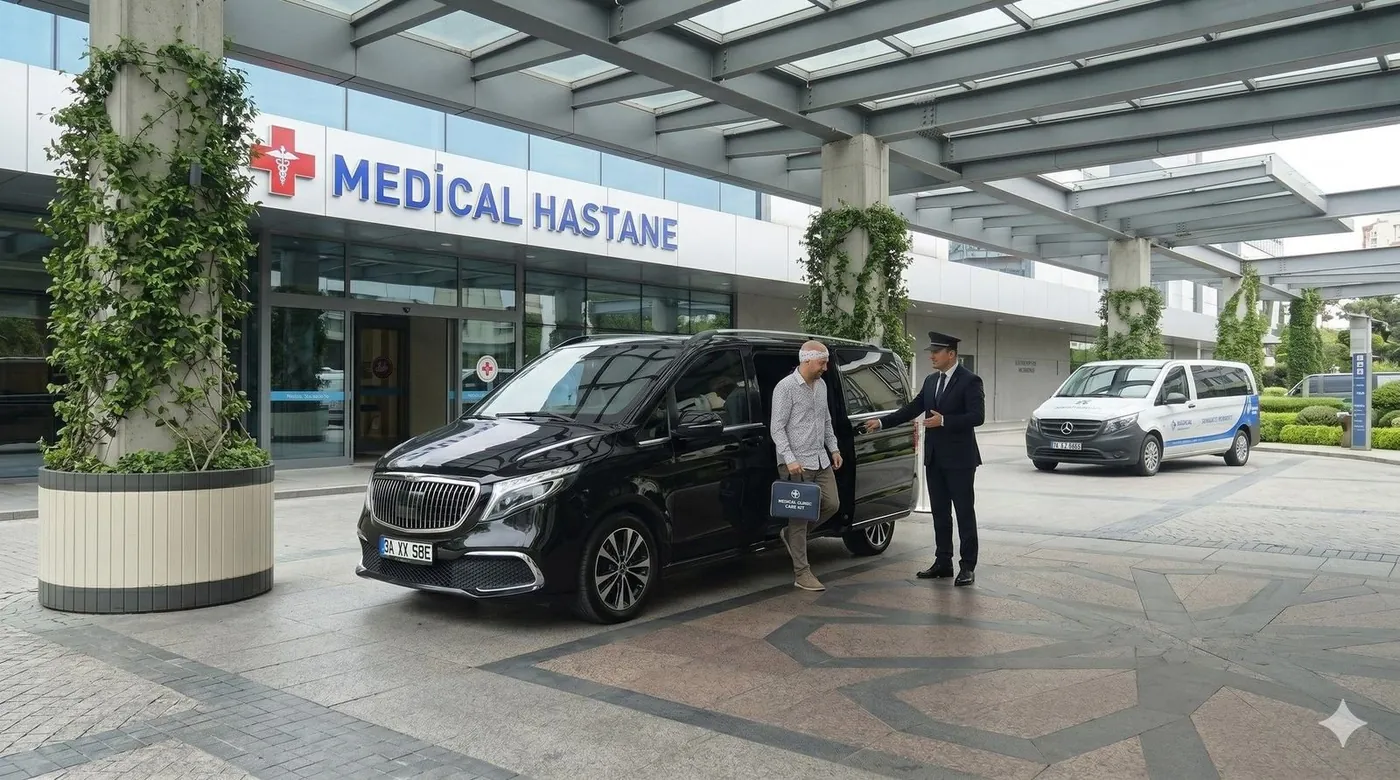
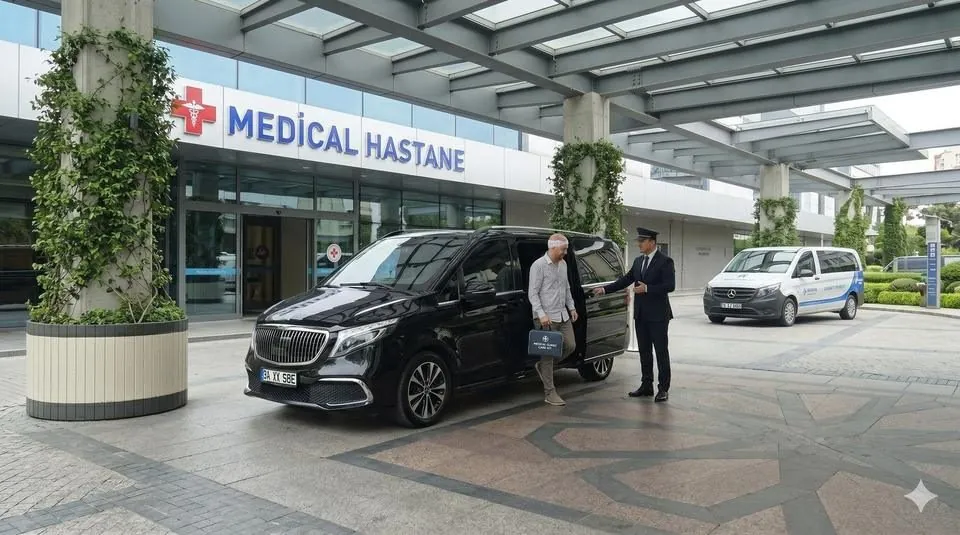
At this point, a planned and comfortable VIP transfer service from the airport to the hospital, and from the hospital to the hotel, becomes an integral part of the treatment process. Especially in the post surgery period, a smooth, calm vehicle ride also positively affects the recovery process.

In health tourism, transport is rarely something the patient arranges alone. More often the plan is made by the agency bringing the patient from abroad, or by the international patient department of the hospital providing the treatment. We work with three separate parties.
For agencies that meet the patient in their own country and stay with them until treatment ends, transport is the visible face of the package. When the flight list reaches us in advance, a vehicle and a driver are planned for each patient from the outset; the agency does not have to arrange a car one by one during the day.
For international patient departments, transport is part of the treatment schedule. Once appointment times are shared with us, hotel–hospital movements are built around that schedule; the patient is not late for the examination and the department does not have to organise transport every single time.
The same arrangement applies to patients and their families who contact us directly. A single plan is built covering every day of the stay; before each journey you already know who is coming and when.
An ordinary transfer from the airport to a hotel and the transfer of someone who is going to receive treatment are not the same job. The difference is not the class of the vehicle but the way the plan is built.
| Standard transfer | Patient transfer | |
|---|---|---|
| Planning | One journey, one time slot. | Tied to the treatment schedule; a sequence of movements spread over days. |
| Vehicle choice | Based on passenger count. | Based on passenger count and on how easy the vehicle is to get in and out of. |
| Companion | Usually not accounted for. | Asked about from the start; seating and luggage are allocated accordingly. |
| Timing | Based on the flight time. | Based on the appointment time; if the examination runs long, the wait is planned for. |
| Driver | May change during the day. | The same driver wherever possible; the patient does not meet someone new each time. |
| Point of contact | The passenger themselves. | The agency or the hospital department; everything runs through one point. |
Soliga Travel provides a transport and travel service; it does not provide medical care, ambulance services or healthcare. Every matter relating to treatment rests with your hospital.
The time a patient spends in the city is not a single journey. The four steps below cover the transport side of a treatment visit from beginning to end.
The flight number is recorded on the booking and the flight is tracked. The driver waits in the terminal with a name sign; the patient and companion do not have to find their way through the crowd. If the flight is delayed the plan shifts on its own and nobody needs to inform us.
Treatment usually spreads over several days. The journeys between hotel and hospital are set up in advance around appointment times; the patient does not have to look for a car each morning.
There are short journeys for tests, dressings or check-ups. Rather than opening a separate booking for each one, the whole visit can be run under a single plan.
The return is the most delicate part of the journey after treatment. The departure time for the airport is calculated backwards from the flight and planned together with luggage assistance.
On health journeys the choice of vehicle is decided as much by ease of getting in and out and by the number of companions as by comfort. Two vehicle classes cover most of this need.
The first choice in most cases where there is a patient and one or two companions. The side door is wide and the floor height suits better than a sedan; for a passenger with limited mobility, getting in and out is markedly easier. The luggage space takes the suitcases of a long stay.
For patients arriving with a large family and for groups of patients on the same flight. When an agency meets more than one patient on the same day, a single vehicle can collect them together, which reduces both the waiting time and the number of cars.
With agencies and clinics that send patients regularly, we work under a framework agreement rather than booking by booking. In this arrangement the patient list reaches us in advance, a vehicle and driver are planned for each patient from the outset, and a single account is issued at the end of the month.
The real benefit of working corporately is having one point of contact. If something goes wrong there is an organisation to call; which vehicle, which driver and what time the journey started are all on record. The international patient department or the agency does not have to follow up each movement separately.
Soliga Travel has operated as a TÜRSAB-member travel agency since 2011 (Licence No: 7056). Please get in touch to discuss the terms of an agreement and the arrangement that suits your patient volume.
Soliga Travel offers end to end comfortable transportation organization for guests coming for health tourism, from the airport to the hospital and through follow up appointments.
Planned, comfortable transfers between airport hospital hotel.
Smooth driving, quiet and air conditioned premium vehicles.
Communication available in English and Arabic for foreign patients.
A transfer schedule that can be planned around your follow up appointments.


Transfer TipsWhat should you pay attention to when transferring to or from IGA Istanbul Airport? A comprehensive guide on booking, pricing and service quality.
Read More
Travel Guide10 critical tips you need to know before planning the Cappadocia balloon tour, one of the most unforgettable experiences of your life.
Read More
Tour RecommendationsWhat is the best time to take a yacht tour on the Bosphorus? Which route should you choose? The complete Bosphorus yacht tour guide.
Read More